Stone Wall or Timber Cladding: Reading a Building’s Outer Skin
Stone wall or timber cladding: learn to read texture, pattern and visual mass without mistaking an outer finish for proof of a building’s age or origin.
A stone wall usually reads as a collection of pieces; timber cladding reads as a surface arranged in boards. That first distinction makes stone wall or timber cladding a useful way to describe a rural building’s outer skin, provided you treat what you see as evidence of appearance rather than proof of its history. Texture, pattern and visual mass can be observed directly. Age and origin need more than a glance.
What does the outer skin show?
In building description, the outer skin is the visible material or finish on the outside face. It may be the main wall itself, or a covering fixed over another construction. From a path or lane, it is often impossible to tell which. A stone-faced wall, a rendered wall and timber boards can each conceal a different structure behind them.
Begin with the features you can actually see. Is the surface made of separate units, continuous boards or an uninterrupted plane? Do joints form a regular grid or an irregular network? Does light catch projecting edges, grooves or rough faces? These observations give a sound description without asking the material to tell a story it cannot confirm.
For example, “a low building with pale, roughly coursed stone walls and a dark roof” records visible qualities. “An old farm building built by local hands” makes claims about date, use and makers that the exterior alone may not settle. The first description can be sharpened by looking more closely; the second needs independent evidence.
How does stone create texture and mass?
Stone often appears visually substantial because the eye can follow individual blocks or smaller pieces across the wall. Their edges make a broken pattern of shadows. Roughly split faces may have ridges and shallow hollows, while dressed stone has flatter surfaces and clearer edges. The overall effect depends on the stone, how it was shaped, and how the pieces meet.
Look at the courses: the horizontal rows in which masonry may be laid. Even rows of similar-height blocks produce a different rhythm from rubble masonry, where pieces vary in shape and size. A wall can also include larger stones at corners, narrow bands of another material, or pale mortar lines that make the joints conspicuous. Name these visible features separately rather than using “stone” as a complete description.
Mass is an impression, not a direct measure of what supports the building. A thick-looking wall, deep window reveals and a heavy-looking base can make the building seem grounded. But a thin stone facing may present a similar surface, and a rendered or painted wall may hide a heavier structure. It is safer to say “visually weighty” or “deeply set windows” than to assert how the wall was built from the outward appearance alone.
Stone suits a description focused on a wall’s varied surface, the contrast between blocks, and the way the building seems to sit against its setting. If the stones blend into the ground colours, note that too. A wall of pale, finely cut blocks can look crisp and orderly rather than rugged; stone does not always mean roughness.
What pattern does timber cladding make?
Timber cladding is an outer covering of boards. The board edges set up a pattern, often horizontal or vertical, while the grain, knots, paint and weathering add smaller marks. Horizontal boards can make a wall seem extended along its length; vertical boards draw the eye upwards. These are visual effects, not reliable clues to the building’s original purpose.
Notice how the boards meet. Overlapping boards make shadowed horizontal lines. Boards joined edge to edge create a flatter plane, while narrow battens fixed over the joints add a repeated raised pattern. A change in board width, direction or finish can divide a façade into sections. Describe the arrangement before reaching for broad labels such as “traditional” or “modern”.
Timber may look light beside masonry, especially when the boards are narrow and the wall has little visible relief. Yet dark paint, deep overlaps or pronounced battens can make the surface appear dense. Colour matters, but it can change with maintenance and exposure. Faded paint, silvered boards and darkened patches tell you what the surface looks like now; by themselves, they do not establish when it was installed.
Timber suits readers describing repeated lines, a distinct board direction, or a changing surface of grain and finish. To make the description precise, include whether the boards are painted, stained or apparently unfinished only when the finish is clear. “Greyed horizontal boards beneath a shallow eaves line” is more useful than “a weather-beaten old cottage” if age is uncertain.
How can you compare the two without guessing?
Use the same viewing questions for both materials. This keeps attention on what the wall presents, rather than on assumptions attached to stone or timber.
- Surface units: Are there separate stones, continuous boards, or a smooth coating? Record the visible arrangement.
- Direction: Do joints run mainly horizontally, vertically or in a varied pattern? Say which direction leads the eye.
- Relief: Are edges, joints or grain raised enough to cast visible shadows? Describe the contrast as shallow or pronounced.
- Colour: Is the surface uniform, mottled, painted or marked by contrasting joints? Note the present appearance without treating colour as a date.
- Visual weight: Does the wall seem grounded, compact or light in relation to the roof and openings? Frame this as an impression, not a structural finding.
- Edges and openings: Do window surrounds, corners or doorways use a visibly different material or finish? Describe the contrast without assuming it is original.
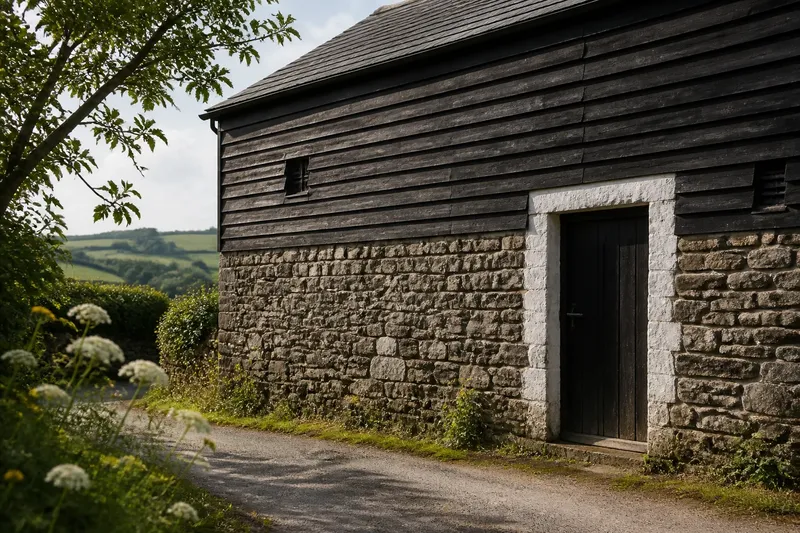
Say you are describing an invented, hypothetical former store beside a rural lane. From the opposite verge, you see irregular grey stones around the lower wall and broad, dark horizontal boards above, with a pale strip around the door. A careful note would identify the change in material, the uneven stone pattern and the boards’ direction. The visible shift may divide the façade into two bands, but it does not show whether the upper boards are original, later, or covering another wall.
When two materials appear together, resist forcing the building into a single category. A stone base with timber above may be the most accurate and revealing description. You can also note where one surface meets another: a sharp change at a level line differs visually from a patchwork of repairs around openings.
Which description suits what you notice?
Choose the wording that brings the strongest visible feature forward. If the wall’s individual pieces and irregular joints dominate, lead with stone and specify its coursing or finish. If repeated board lines dominate, lead with timber and state their direction and surface treatment. If neither does, describe the contrast or the overall impression without ranking one material as more important.
A short description can combine material with one effect: “rough stonework gives the front a broken texture” or “vertical boards emphasise the gable’s height”. Keep the effect modest. Words such as “seems”, “appears” and “visually” make clear that you are describing perception, not claiming knowledge of construction.
It is not worth trying to infer a precise date from a colour, a rough finish or a familiar-looking pattern. Nor is a catalogue of every mark useful if it obscures the main contrast. Select the details that help a reader picture the wall: material, arrangement, texture and the impression of weight.
What questions help describe stone and timber?
Does a stone wall mean the building is old?
No. Stone may be used in buildings of different ages, and a stone-looking exterior may be a facing rather than the full wall. Describe the visible masonry and keep any claim about age separate.
Can timber cladding reveal what is behind it?
Not reliably from an ordinary exterior view. Boards may cover another surface or form the visible outer wall, so describe the cladding as cladding without naming concealed construction.
What is the difference between coursed stone and rubble?
Coursed masonry has stones arranged in recognisable horizontal rows, though the rows need not be perfectly even. Rubble masonry uses stones of varied shapes and sizes, often with a less regular visible pattern.
How should I describe a wall that combines both materials?
Name each material and where it appears, such as “stone below, horizontal timber boards above”. Add the visual effect of the boundary if it is noticeable, without guessing why the materials meet there.
What makes a description dependable?
A dependable description separates observation from interpretation. Start with the visible material, then mention its pattern, surface and apparent weight. If a building has stone and timber together, say where each occurs. If the wall’s structure or history is unclear, leave it open rather than filling the gap with a plausible story.
Stone wall or timber cladding is therefore a useful comparison of surfaces, not a test of age or origin. Stone often offers a varied pattern of pieces and a strong impression of mass; timber often offers directional lines and a more continuous plane. The most useful account stays close to those visible differences, giving another person enough detail to imagine the building without mistaking appearance for proof.