A Place Name Is Not a Complete History
A place name can suggest what to investigate, but checking its limits helps you separate a useful clue from unsupported claims about local origins.
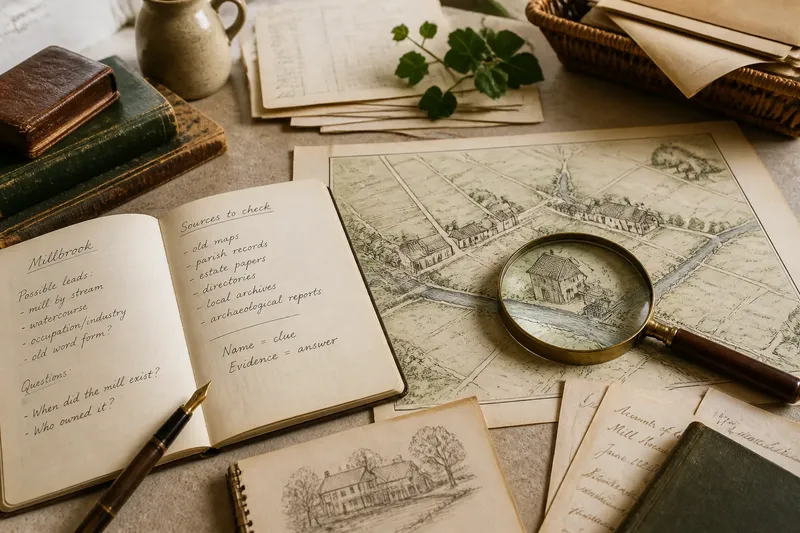
A place name can point towards a useful question, but it cannot, by itself, tell you how a settlement began or who lived there. A name such as Millbrook might prompt a search for a mill and a stream; it does not establish that a mill stood there, when it operated or who owned it. Treating names as clues rather than compact histories makes local research more accurate—and often more interesting.
Why can a familiar name mislead?
Place names are labels passed between people, not tidy records written to explain a location to future readers. Their forms can change as they are spoken, written down, copied onto maps and adopted by new residents. A modern spelling may preserve part of an older form, but it may also reflect later pronunciation or a clerk’s interpretation.
Even a name that seems transparent can have several possible explanations. The words may once have meant something different, or the current form may have been reshaped until it resembles familiar words. A reader who sees “field” in a name cannot assume that the place has always been a field, or that the name describes its first use.
The first useful habit is to separate what is visible from what is inferred. “The village is called Millbrook” is an observation. “The village began around a watermill” is a claim that needs evidence beyond the name.
What can a name actually tell you?
A name can help narrow a search. It may suggest a landscape feature, an activity, a person, a community or a relationship between places. It can also preserve a word or sound that is no longer familiar. These possibilities are leads, not findings.
Consider a hypothetical hamlet called Ashcombe. The first part might invite questions about ash trees, while the second may suggest a valley or hollow. Neither interpretation establishes the vegetation or settlement pattern at the time the name arose. The name becomes more useful when it helps you decide what to look for in old maps, local records and the shape of the land.
Names can also reveal how people classified a place at some point in its history. A name referring to a ford may indicate that a crossing mattered to those who used or recorded it. It does not show that the crossing was the reason the settlement began, or that the same route served every period.
How can you test a tempting explanation?
Start by writing down the claim in a form that could be checked. “The name may refer to a mill beside the stream” is easier to investigate than “the village grew up around its mill”. Then look for evidence that is independent of the name itself.
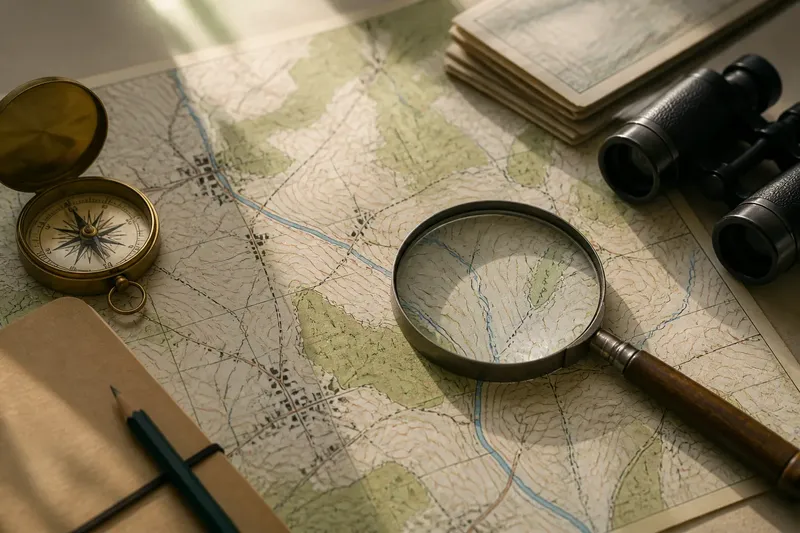
Useful sources can include historic maps, parish records, estate documents, directories, archaeological reports and local archives. Each has limits. A map may label a building without explaining its age; a record may mention an owner without showing where that person lived. Read each source for what it actually records, not for the whole story you hope it will confirm.
Compare the place’s earlier written forms where reliable records are available. A sequence of spellings can help explain how the modern name developed, though it does not necessarily settle the meaning. If the early forms differ sharply from today’s, a neat interpretation based on modern words may be less convincing.
Then ask whether the proposed explanation fits other evidence. If the name seems to refer to a mill, do maps or documents show one in a plausible location? If it suggests a crossing, is there evidence of a route or ford nearby? A match makes the idea worth considering; it still does not prove that the feature gave the settlement its name.
Which questions help separate clues from claims?
Does the modern spelling preserve the original meaning?
Not necessarily: spelling and pronunciation can change, and familiar-looking parts may be misleading. Seek earlier recorded forms before assigning a meaning to today’s version.
Can a place name identify who lived there?
It may refer to a person, family or group, but the name alone rarely establishes identity, residence or social status. Look for independent records that connect named people or communities with the place.
Does a name prove what the settlement was built around?
No. It may point to a feature that mattered at some stage, but the name does not establish when that feature appeared or whether it shaped the settlement’s beginnings.
What if local explanations disagree?
Record the competing interpretations and the evidence each uses instead of choosing the most appealing story. An uncertainty honestly stated is more informative than a confident explanation with no supporting record.
Why do several sources matter?
A claim gains strength when different kinds of evidence support it. A name interpretation, an old map and a document describing a nearby mill may fit together, but check whether they refer to the same period and location. Similar words on separate records do not automatically describe the same feature.
Sources can also depend on one another. A local booklet may repeat an explanation from an older guide, which in turn drew on the same unverified guess. Three versions of one story are not three independent confirmations. Look for the earliest source you can inspect and note whether it cites evidence of its own.
For a modest enquiry, a simple record of claims can prevent confusion. Note the proposed meaning, the source, what that source directly says and what remains an inference. This need not become elaborate. A few clear notes make it easier to distinguish a documented fact from a plausible interpretation.
What is not worth the effort?
It is usually not worth forcing every syllable into a modern word or searching for a single dramatic origin story. That approach rewards resemblance over evidence. Nor does a name need to have one settled explanation to be worth discussing; several readings may remain possible.
Say you are researching a fictional place called Millbrook and find an old map marking a mill downstream from the houses. That gives you a mill, a location and a period represented by the map. It does not show that the mill existed when the settlement began. A careful note would say that the map records a mill near the settlement, while the name’s origin and the mill’s role in the village’s formation remain unconfirmed.
How should you describe what you learn?
Choose words that match the strength of the evidence. “The name may refer to…” signals a possibility. “An early map shows…” identifies what a source records. “This suggests…” connects evidence to an interpretation without claiming certainty. Avoid turning those phrases into a flat assertion as the account is retold.
Keep three questions separate: what the name may mean, what features or activities existed there, and how the settlement formed. Evidence for one does not automatically answer the others. A record of a mill can establish that a mill was recorded; it cannot, without further support, explain the beginning of the village.
When you write about a local name, give readers enough detail to check your reasoning: identify the record or map, its relevant wording and the point at which interpretation begins. The result may be less tidy than a single origin tale, but it gives the place name its proper value—a starting clue, not a complete history.