A Rainy Afternoon for Watching the Season Turn
A rainy afternoon for watching the season turn: use one sheltered view to notice shifts in light, colour and land without disturbing the countryside.
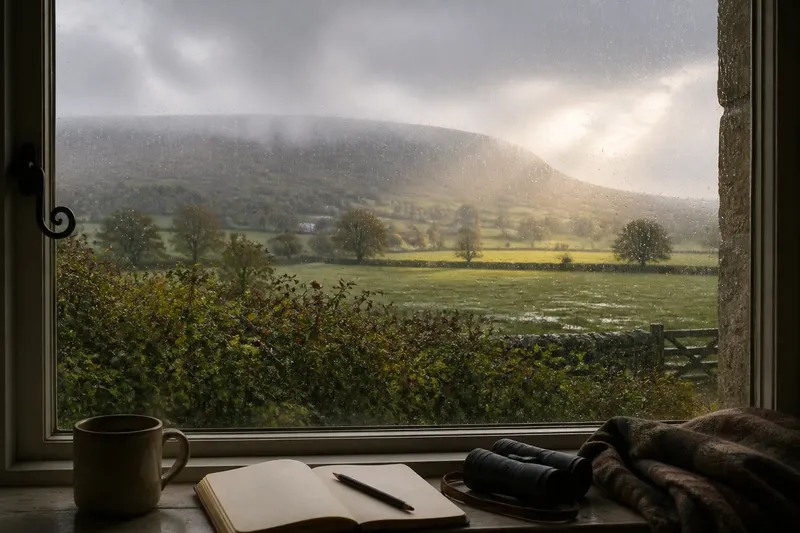
A rainy afternoon for watching the season turn can reveal changes that a bright walk past might hide. From a kitchen window or sheltered bench, watch how the cloud light alters a field, hedge and distant slope; let the view itself set the pace.
The point is not to identify every plant or predict the weather. It is to notice how familiar outlines and colours respond as the afternoon moves on. A quiet, repeatable viewpoint makes those small changes easier to see, and leaves the landscape undisturbed.
How can one viewpoint tell a seasonal story?
Choose a place with a clear view of several layers: something close, such as a garden hedge; a middle distance, perhaps pasture or orchard; and a far edge, such as a wooded rise. A window with a view across fields works well. So does a porch or bus shelter, provided you can sit without blocking anyone or straying onto private land.
Each layer gives you a different clue. Nearby leaves show the direction and force of rain. A field may look darker where water has settled, while the far slope can fade almost entirely into mist. Because these things occupy the same frame, you can compare them without moving around or disturbing plants and animals.
Say you are indoors on a grey afternoon, looking towards a low pasture bordered by hawthorn and a wooded ridge. At the start, rain softens the ridge and the hedge holds most of the colour. Later, a brighter patch of cloud reaches the pasture, making its wet grass appear lighter while the ridge remains veiled. The observable change is not a dramatic transformation but a shift in contrast: the land comes forward, then recedes again.
What should you notice as the light changes?
Begin with the outline of the land. Look for the ridge, field boundaries and the line where trees meet sky. Rain can blur these edges; a break in the cloud may sharpen them. The shape has not changed, but its visibility has, which is a useful distinction when observing a landscape through unsettled weather.
Then compare colour and brightness. Wet bark and stone often appear darker than dry surfaces. Grass may seem silvery beneath a bright cloud and deep green beneath a heavier one. Rather than deciding that the whole scene has changed colour, notice which part is brighter or duller and whether the change lasts.
Finally, attend to movement and stillness. Raindrops can make leaves flicker, while the far field remains visually quiet. A gust may turn the undersides of leaves towards you, briefly changing the hedge’s tone. These brief shifts offer a sense of the season without requiring you to collect samples or touch anything.
How can you compare the same view over an afternoon?
Keep the observation simple. Sit somewhere dry, frame the view with a window edge or a fixed point on a veranda, and make a few notes on paper if that helps. Avoid trying to record every passing shower. A compact set of observations is easier to compare and less likely to turn a restful pause into a task.
- Choose a fixed frame. Use a gatepost, window frame or tree trunk as a reference so your gaze returns to the same part of the scene.
- Note the sky’s brightness. Describe it in plain terms such as even grey, brighter to the west or broken cloud.
- Track one near feature. Watch a hedge, roof or tree crown for movement and changes in colour.
- Track one distant edge. Check whether a ridge or treeline is clear, softened or hidden by rain.
- Notice a change in the middle ground. Look for differences in the appearance of a field, orchard or path, without entering it.
- Record the time in words, if useful. “Later in the afternoon” is enough when exact timing adds nothing to your comparison.
There is no need to keep a detailed weather log or photograph the view from several angles. Those efforts can pull attention away from the actual changes, and repeated photographs may make you focus on matching a frame rather than looking carefully. A short note or a remembered contrast is plenty.
Which details are easiest to miss?
Rain can make distance deceptive. A distant line of trees may seem lower or closer when the surrounding fields fade, while a dark hedge can look unusually solid against a pale sky. Compare outlines against a stable reference, such as a familiar roofline, rather than assuming that the land itself has shifted.
Colour also depends on what lies beside it. A grey stone wall can look warm next to cold cloud, then cool when a brighter patch illuminates the grass. This is why it helps to describe relationships: “the wall stands out more than the field” is more useful than claiming that the wall has changed colour.
Pay attention to the gaps as well as the visible objects. A break in a hedge may reveal a field that was previously lost in rain. When the view clears, the opening can make the countryside seem newly arranged, although its boundaries have stayed put. The season is expressed partly through what the weather allows you to see.
What questions help make sense of the view?
Can I watch the season turn from indoors?
Yes. A window gives you a steady, sheltered view and makes it easy to compare the same outlines as the light changes. Choose a vantage point that does not require entering land or approaching wildlife.
What should I write down?
Record a few visible contrasts: whether the ridge is clear, which part of the field looks brightest, or how the hedge moves in the wind. Plain descriptions are more helpful than trying to name every plant or cloud.
Does rain make a landscape harder to read?
It can soften edges and hide distance, but that is part of what you can observe. Notice which layers disappear first and whether a passing bright patch brings them back into view.
Do I need a camera or specialist equipment?
No. A dry seat and an unobstructed view are enough, and a notebook is optional. Binoculars can bring distant details closer, but they are not necessary for noticing broad changes in light and outline.
What can you take from a single afternoon?
Return to the view before you leave, and compare it with the first impression you wrote down or remember. Perhaps the near hedge is still dark, but the distant ridge has emerged; perhaps the field has lost its shine while the sky remains bright. The result is a small, specific account of how this place looked as the weather moved through.
A rainy afternoon for watching the season turn works best when observation stays gentle. Let the fixed view do the work: look from near to far, notice what becomes clearer or less distinct, and leave the landscape as you found it. You may finish with no grand conclusion, but with a sharper sense of how light and weather give a familiar stretch of countryside a different character.